 |
Coastal Technologies Group, Inc.Serving Telecom Providers |
|
|
|
Trouble Analysis InformationEnterprise wide visibility to fault information
TAS IntroductionIn today’s telecommunications industry, service providers must deliver an excellent quality of service in order to gain entry to the playing field. Managing both service levels and the customer's perception of service levels is crucial.In order to be successful in this environment, service providers must be able to quickly and accurately identify the root causes of failures, notify customers promptly, and have all available information on hand delivered to the customer agents and field technicians. Electronic storage and manipulation of network configuration is essential, as is the sharing of this data throughout multiple operational support systems (OSS). TAS is a distributed, scaleable trouble analysis platform that allows service providers to proactively manage all aspects of a network’s performance by making failure and configuration data available enterprise wide. Availability of data allows for faster and more efficient troubleshooting, and enables excellent communication with the customer and exchange partner, enhancing the service provider's image. TAS proactively improves service levels by correlating failures and performing root cause analysis. Design and repair functions benefit from data availability. TAS Functional ArchitectureThe TAS integrated architecture is presented below.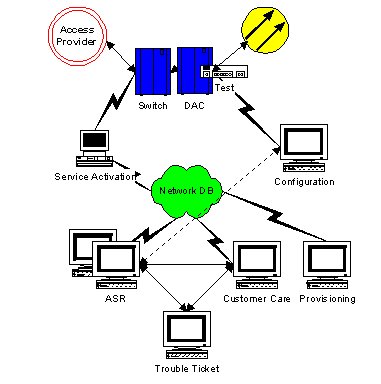 TAS Business BenefitsUsing TAS provides many immediate business benefits to a service provider:Diagnose failures: TAS utilizes provisioning data to look for common failure points among tickets. This auto diagnosis can correlate tickets and alarms to take an educated guess at likely failure points. Distribution of configuration and test data to field technicians greatly improves repair times. Retain failure data: TAS provides a database allowing for quality and SLA studies and credits. Improve service quality: TAS provides for the immediate availability of network data for repair and testing. This data is included with the forwarded trouble ticket. Resolution codes allow for service improvement studies. Provides full suite of analysis: time to clear, resolution, workflow, history. Reduces trouble rates by finding the causes of repeat troubles. Reporting: TAS provides minimum and maximum response times per technician, per location, per skill set, and per resolution code. Knowledge Base: TAS builds a knowledge base as tickets are opened and resolved. A previous request/resolution scenario may resolve a current issue. Problems may be searched and cross referenced. Cross reference circuit IDs: TAS cross references circuit IDs from our ASR and PRV modules to allow the forwarding of tickets to off-net suppliers. Workload assignment : TAS distributes and manages workload throughout the organization. This workload capability may be used to distribute information packets extending beyond tickets to encompass most corporate functions. Extensive reporting on repair intervals allows the tracking of employee and corporate performance. Flow through handling: TAS interconnects with billing, customer care, service activation and provisioning systems to provide flow through management of failures. This eliminates re-keying and improves accuracy. Coastal’s OSS modules share a queuing system allowing for the free flow of work packages/alert emails throughout an organization. Coastal has licensed the Microsoft Agent, Microsoft VBA and Office Automation technologies for use in our platforms. Interface to your billing platforms for accurate credits: TAS directly supports SLA credits in billing systems. Failure clocks may be stopped and started as tickets are moved to off-net suppliers. Scripts: TAS provides scripts to allow non-technical customer service personnel to gather information required to diagnose problems for more complex dedicated services. This eliminates call-backs by technicians trying to resolve problems, and may allow customer service to resolve problems they would otherwise be unable to resolve. Interface to your customer: Tickets may be opened and status checked over the Internet with a remote, highly secure client. Failure notifications and estimated time to repair figures may be broadcast via fax, email, pager and web page. Auto ticket generation: When linked to the TRF or NM modules, or to external monitoring systems, tickets may be auto-generated to expedite follow up. Too many overflow calls onto AT&T … Open a ticket. Auto re-route: With NM and a DAC network, circuits may be re-routed via pre-planned scripts. Electronically Transmit/Receive Tickets: TAS interconnects with other carriers to transmit tickets via electronic bonding and supports GR-2872-CORE. OptionsGIS: TAS integrates with mapinfo to provide graphical depictions of trouble locations. OSS systems benefit greatly from GIS tools.Voice: TAS integrates with Coastal's CTI app (Interactive Voice Response) to provide automated ticket status over the phone (enter your customer or ticket number … your ticket will be resolved by 6pm.) Very useful in handling mass outages. TAS Technical Features and BenefitsTAS has been designed to grow with the service provider’s network and customer base. TAS uses an open, standards-based, distributed client / server architecture. Some key features and benefits include the following:
|
|
|
All content contained herein, unless otherwise stated, is the sole Copyright © of Coastal Technologies Group, Inc, 2002. All rights reserved. |