|
Call Management Platform
CMP: CALL MANAGEMENT PLATFORM
Visibility to network traffic in real time is critical
- Introduce new services
- Reduce your fraud liability
- Improve your reseller relations
- Quickly detect aberrations in routing
CMP Introduction
In today’s telecommunications industry, service providers need to interconnect with partners and competitors alike. Competition, deregulation, technological change, and a fluid customer base create an ever-increasing management challenge.
In order to be successful in this environment, service providers must be able to quickly and accurately monitor network call patterns and leverage this data throughout multiple operational support systems (OSS).
CMP is a distributed, scaleable, call processing platform that allows service providers to proactively manage all aspects of a switched network’s performance by making raw and summarized call detail available enterprise wide. Availability of data in near real time reduces fraud liability, improves customer complaint handling, allows support of credit impaired customers (balance control), and enables the introduction of new services. CMP even helps audit interconnect bills by capturing the call data for later audit of access and exchange billing, which can greatly reduce operational costs. Design and repair functions benefit from immediate CDR data availability.
CMP Functional Architecture
The CMP integrated architecture is presented below.
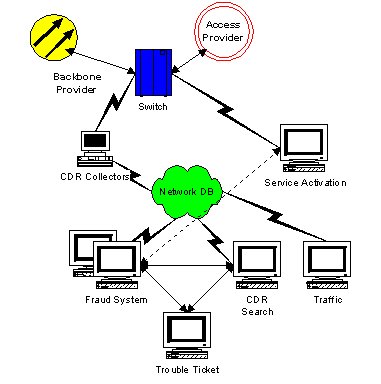
CMP Business Benefits
Using CMP provides many immediate business benefits to a service provider:
- Offer More Products: CMP provides a high-performance CDR management solution that can help you offer new products. Balance control products for credit impaired or new customers become possible, without the need for service deposits. Calling card products that would otherwise carry too high a fraud liability may now be issued. Daily or even near real time supply of call data to business customers and resellers is supported. Residential call detail and preliminary bill summaries over the internet may be provided with a remote client.
- Reduce Fraud Liability: CMP provides a self learning fraud module, which learns each customer’s calling pattern and looks for aberrations. In addition, alerts from CMP are graded by fraud technicians (real alert vs. false alarm) and this data is used by an artificial intelligence module to improve CMP’s overall performance. CMP actually learns your customer and overall network patterns, and adapts itself on an on-going basis to your ever growing/changing network. The fast A.I. engine and the network database are patent pending. The A.I. engine will support hundreds of fraud checks in real time, as incoming CDRs are graded by their fraud likelihood on a distributed basis. The ongoing accuracy of these checks, both independently and in combination, become the basis for the CMP’s fraud knowledge base.
- Improve Service Quality: CMP provides for the immediate availability of calling data. Because it assigns searching a lower priority, switching gear, frequently fails to provide a timely search. With CMP, customer calling records can be retrieved while the customer is on the line (this depends on the speed of collection from the switch).
- Reduce Service Costs: CMP manages down the overhead of fraud, including subscription fraud and non-payment issues. With our service activation module, CMP provides a single, integrated high-performance gateway to the network that eliminates the need for all OSSs to connect to switching elements. For example, terminals to switching gear to pull up CDRs are no longer necessary, as that function is provided by CDR search, and the switching gear has additional work offloaded by not having to support searches.
- Flow-Through Handling: CMP interconnects with billing, customer care, service activation and ticketing systems to provide flow through handling of alerts, balance control, and searches. This reduces the time to research items, and eliminates double keying. If a customer is deactivated due to a fraud alert, customer service knows about it before they call. If they are dialing the wrong calling pattern, customer service can see the records and correct them. Coastal’s Trouble, Fraud, and Workflow modules share a queuing system based on Outlook98 and exchange server, allowing for the free flow of work packages/alert emails throughout an organization. A secondary queuing system can be provided for smaller installations. Coastal has licensed the Microsoft Agent, Microsoft VBA and Office Automation technologies for use in our platforms.
- Enterprise Wide CDR data: CMP uses a network database to store CDR and usage data in real time for searching and pattern analysis. CDRs are made available to customer service techs for call complaint lookup (they can be attached to a trouble ticket, identifying problem circuits), to fraud techs to help research alerts, to network planning to check on routing and overflow (network stats on trunk groups, destinations) and to line cost to help spot audit intercarrier billing. An internet client may be placed at reseller and customer locations to enable them to perform customer support queries in near real time.
- Large customer support: CMP directly supports PBX customers by giving them alpha numeric pager alerts of fraud and excess calling, and a remote client to pull up the records in question. Security prevents records from one customer being seen by any other customer.
- Scalability: Improved scalability for down stream platforms: CMP improves the top end of down stream systems by doing most of the translation work up front, and providing a digested and correlated billing record to the billing system(s). This can greatly extend the shelf life of billing platforms. CMP also provides routing to multiple billing platforms (by customer, network region, etc.), allowing both a scaling up of billing platforms and the acquisition of other carriers and customer bases. This sounds trivial but can be extremely complex and critical to supporting growth, the phasing in of new platforms, and the rapid change requisite in acquisition.
CMP Technical Features and Benefits
CMP has been designed to grow with the service provider’s network and customer base. CMP uses an open, standards-based, distributed client / server architecture. Some key features and benefits include the following:
- High Performance: CMP is an open, scaleable, high-performance and hardware independent OSS solution that facilitates immediate processing of CDR data. CMP uses distributed processing to handle large volumes of call data. An earlier version of CMP managed a 40M/Day CDR load.
- Data Driven Architecture: CMP is data driven in network topology and interface definitions. This allows the service provider to rapidly define, in a dynamic manner, the call and switching types without the need to alter the source code of the CMP product.
- Network Interface Standards Support: Service provider networks may contain a variety of traditional and modern network element platforms as well as a variety of emerging element management systems. CMP is architected to interface in such a heterogeneous environment and supports technical interfaces and network management protocols including TCP/IP (Telnet and Socket), Asynchronous Serial, Dialup, X.25, ISDN and TCP/IP FTP.
- System Interfaces: CMP has been designed to interface to OSS systems. CMP provides standard procedural as well as object-oriented interfaces over a variety of transport protocols to permit rapid integration with traditional and contemporary systems.
- Open: Runs on inexpensive Intel/Alpha/PowerPC hardware. Uses NT SQL 6.5 or other open DBs for persistent storage. Built with the latest distributed processing and client server development tools.
|
|